
Berliner
Also known as: Cream-filled Berliner · Portuguese doughnut
The golden ball that roams Portugal's beaches to the cry of 'olha a bolinha!'.
- Origin
- Portugal · diffusion associated with German refugees in the 1930s–40s
- Place
- Nationwide
- Region
- Nationwide
- Category
- Fried Sweets
- Season
- Year-round (especially summer)
- Evidence
- Well documented
The bola de Berlim is a ball of soft, yeasted dough, deep-fried, rolled in sugar while still warm and split down the middle to take a generous filling of bright-yellow egg custard. There is no hole: it is round, plump and golden all the way through.
Despite the German name, the Portuguese version long ago parted ways with its Berlin cousin. Where the German one carries fruit jam, ours carries a yolk-rich egg custard — sweeter, richer, unmistakably Portuguese.
Above all, it is the sweet of summer. You will find it in every café, but its true kingdom is the beach, where vendors carry it in cool-boxes and hawk it from towel to towel.
- flour
- baker's yeast
- eggs
- milk
- butter
- sugar
- frying oil
- egg custard
A thin, lightly crisp fried crust, a soft, springy crumb, and a centre of silky, very sweet egg custard. The granulated sugar outside meets the vanilla and lemon of the cream within. Warm, it is heavenly; straight from the fridge, it loses its charm.
The egg custard is the benchmark, but versions abound: unfilled (German-style, just sugared), with whipped cream, doce de ovos, chocolate, dulce de leche and, more recently, hazelnut, Kinder or red-berry fillings. There is also a baked bola de Berlim, lighter, for those who shun frying.
At a good neighbourhood pastelaria, always fresh and brimming with cream. In Lisbon, Sacolinha — born in Cascais — is a classic reference. But the most Portuguese way to eat one is on the beach, bought from a cool-box to the cry of 'olha a bolinha!', with your feet in the sand.
On the beach, all you need is the sun and the thirst it stirs up. In a café, a galão or a bica to cut the sweetness.
Bola de Berlim descends from the German Berliner Pfannkuchen, a yeasted fried cake traditionally filled with jam. Historian Irene Flunser Pimentel documents that Jewish refugee Ruth Davidsohn, who arrived from Hamburg in 1935, made the German version in Portugal for refugees and German residents. The historian herself cautions, however, that she does not know whether this was the first introduction; what she considers secure is the association of the cake's Portuguese diffusion with the Second World War years.
The Portuguese adaptation replaced jam with yellow pastry or egg custard and split the cake across the middle. The consulted sources document that difference but neither date the first sale of the Portuguese version nor attribute it to one bakery.
Well documented
Identity supported by institutional, specialist or corroborating sources.
- poligrafo.sapo.pt/fact-check/bola-de-berlim-foi-trazida-para-portugal-por-uma-refugiada-judia-durante-a-ii-guerra-mundial/ (opens in a new tab)
- pt.wikipedia.org/wiki/Bola_de_berlim (opens in a new tab)
- en.wikipedia.org/wiki/Berliner_(doughnut) (opens in a new tab)
- devourtours.com/blog/bolas-de-berlim/ (opens in a new tab)
- foodlab.cascais.pt/pt-pt/bola-de-berlim (opens in a new tab)
- sacolinha.pt/a-melhor-bola-de-berlim-de-lisboa-e-a-nossa/ (opens in a new tab)
Pastries from here — Nationwide
 Catalogue image
 Alféloa
Sugar or molasses cooked to a hard stage and worked until pale.
Nationwide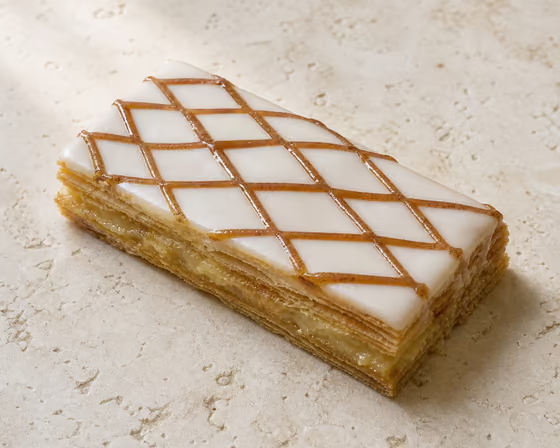 Catalogue image
 Portuguese Gila Allumette
A rectangular puff pastry with cream, gila and cinnamon beneath diamond-patterned royal icing.
Nationwide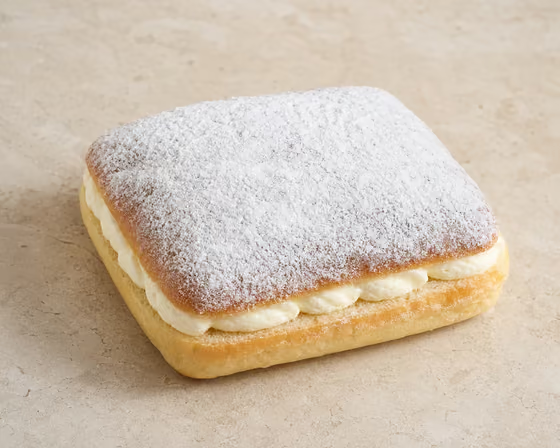 Catalogue image
 Portuguese Brioche Almofada
Light brioche dough, fresh buttercream and icing sugar.
Nationwide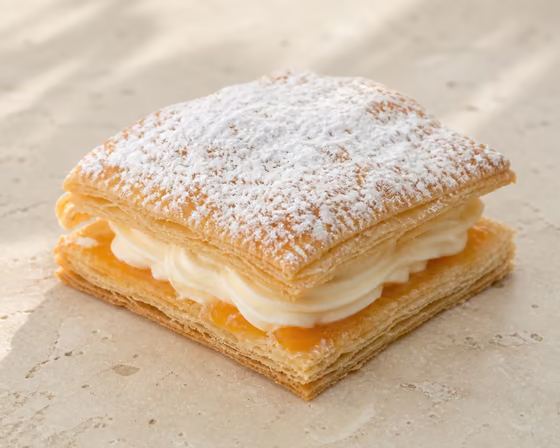 Catalogue image
 Portuguese Puff-Pastry Almofada
Puff pastry with white cream, egg sweet and icing sugar—the laminated Almofada variant.
Nationwide