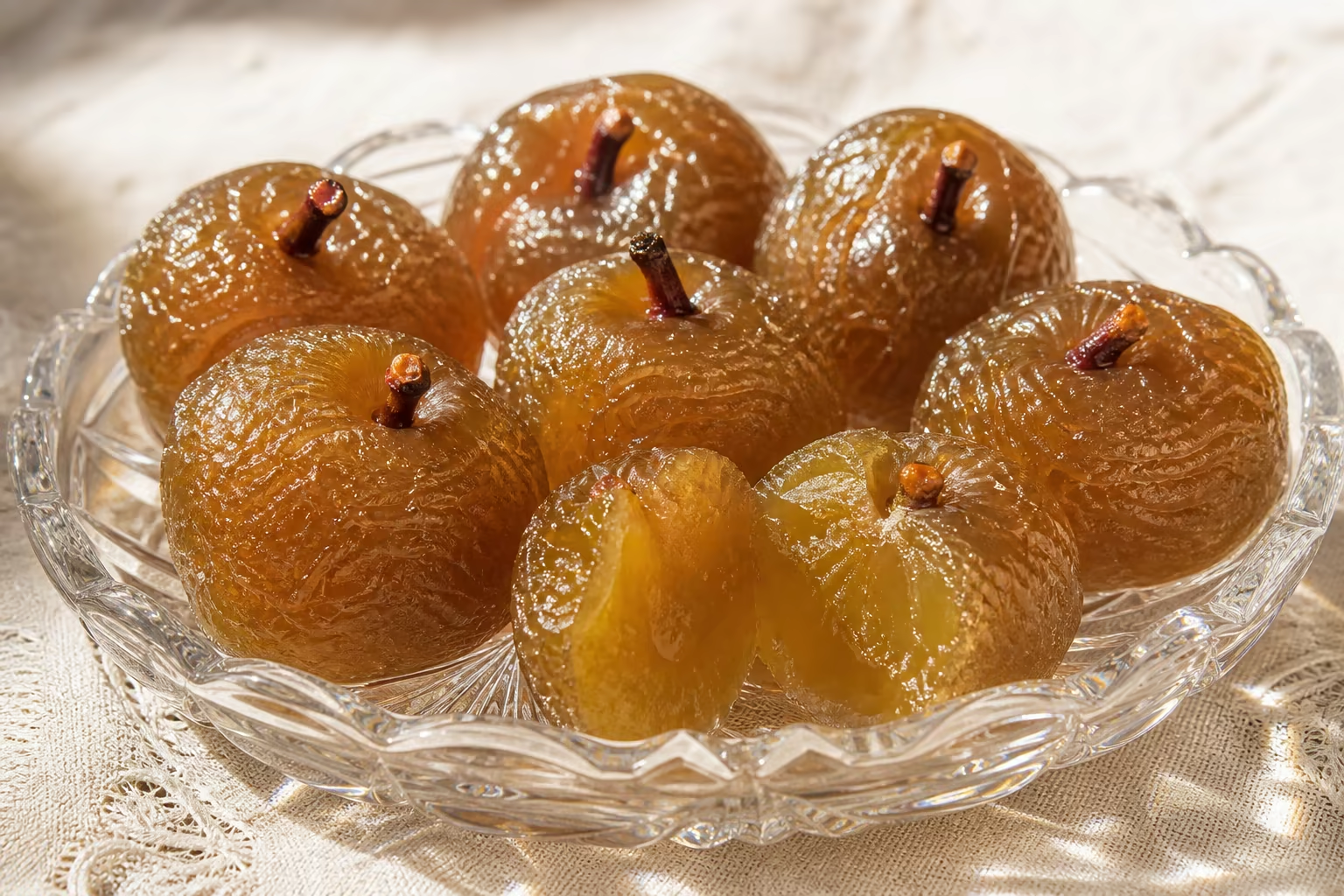
Elvas Plums
Also known as: Ameixa d’Elvas PDO · Candied Elvas greengages
Protected Rainha Cláudia Verde greengages sold fresh, dried or candied—the sweet form requires at least seven days of slow candying.
- Origin
- Upper Alentejo · PDO registered in the European Union on 21 June 1996; exact origin of the candying tradition unknown
- Place
- Elvas
- Region
- The Alentejo
- Category
- Fruit & Honey Sweets
- Season
- Harvested in June and July; later availability depends on processing and the producer
- Evidence
- Well documented
This page focuses on the candied form of Ameixa d’Elvas PDO, but the protected name does not mean only ‘crystallised plum’: the official specification covers fresh fruit, dried fruit and candied fruit. Candied plums may reach the consumer drained and dried, held in syrup, or coated with sugar. A crystalline crust is therefore one permitted presentation, not a feature of every example.
Candying uses whole, stone-in fruit from regional Rainha Cláudia Verde clones. The specification describes washing under running water, cooking in water until the fruit floats—about ten minutes—and moving it through progressively more concentrated syrups: the first must not exceed 40° Brix and the finished product must reach at least 70° Brix. The technical rules limit heating to 70°C / 158°F and require the fruit to remain submerged for at least seven days. Drained fruit is rinsed in cold water and dried in the sun or in a low-temperature dryer.
- regional Rainha Cláudia Verde greengages
- water
- sucrose
- glucose permitted by the technical rules
The specification requires candied fruit to remain whole and stone-in, with a dark-green colour, characteristic aroma and at least 70° Brix. That concentration establishes very high sweetness; the source does not prescribe one exterior texture because syrup-packed, drained and sugar-coated forms are all allowed.
The PDO distinguishes fresh, dried and candied Ameixa d’Elvas. Within the candied form, the specification allows drained and dried fruit, fruit held in syrup at the candying concentration, and sugar-coated fruit. They should not be collapsed into a single description of a ‘crystallised plum’.
Look for the full name ‘Ameixa d’Elvas PDO’ and the certification label. In Elvas, the Plum Factory-Museum presents the small-scale candying industry and sells products on site; check opening hours and availability before travelling.
Elvas municipality documents the syrup-packed plum as an accompaniment to sericaia. Wines, cheeses or coffee would be editorial suggestions rather than pairings established by the reviewed sources.
The official registration application says that the origins of the crop and its transformation are lost in time, that written documents are rare, and that the evidence points to Elvas convents as the first centres of this confectionery. Elvas municipality associates the sweet preserve with the repertoire of the Dominican Convent of Nossa Senhora da Consolação. These sources support a local convent tradition, but they do not date the first formula to a particular century or by themselves establish a surviving sixteenth-century manuscript recipe; the exact chronology remains unknown.
The chronology becomes firm in 1834, when José da Conceição Guerra began industrial production with 45 kilograms / 99 pounds of plums. The specification records 27,000 kilograms / 59,525 pounds in 1864 and 75 tonnes / 82.7 US tons in the early twentieth century, together with 203 national and international prizes over little more than a century. The name was registered as a European PDO on 21 June 1996. Its protected territory covers Alandroal, Borba, Campo Maior, Elvas, Estremoz, Monforte, Sousel and Vila Viçosa within the boundaries defined by the specification.
Well documented
Identity supported by institutional, specialist or corroborating sources.
- tradicional.dgadr.gov.pt/images/prod_imagens/frescos/docs/CE_ameixa_elvasdoc_ae.pdf (opens in a new tab)
- tradicional.dgadr.gov.pt/pt/cat/frutos-frescos/955-ameixa-d-elvas-dop (opens in a new tab)
- dgadr.gov.pt/images/docs/val/dop_igp_etg/Valor/DOP_IGP_ETG_Relatorio_2010_2019.pdf (opens in a new tab)
- eur-lex.europa.eu/legal-content/PT/TXT/ (opens in a new tab)
- cm-elvas.pt/descobrir/gastronomia/ (opens in a new tab)
- visitportugal.com/pt-pt/content/fabrica-museu-da-ameixa-de-elvas (opens in a new tab)
Pastries from here — The Alentejo
 Catalogue image
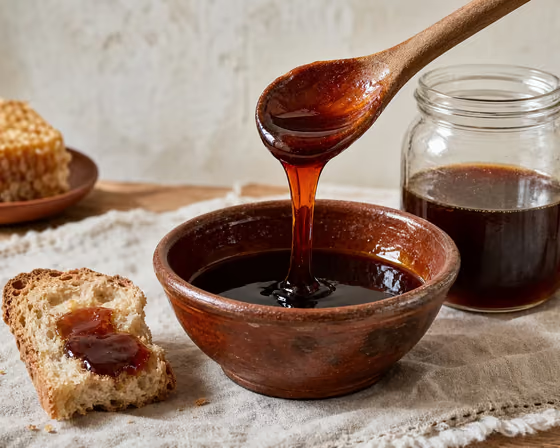
 Portuguese Água-mel Syrup
Water that recovers honey from combs after extraction, filtered and reduced for hours to 70–77° Brix.
The Alentejo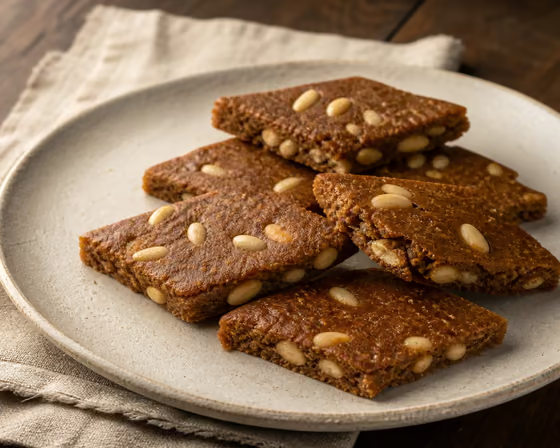 Catalogue image
 Alcomonias
Toasted coarse wheat flour, honey and pine nuts spread and cut into diamonds.
The Alentejo Catalogue image
 Amoreiras-Gare Alcôncoras
A large circular honey-and-olive-oil biscuit born from Amoreiras-Gare's promise-pole tradition.
The Alentejo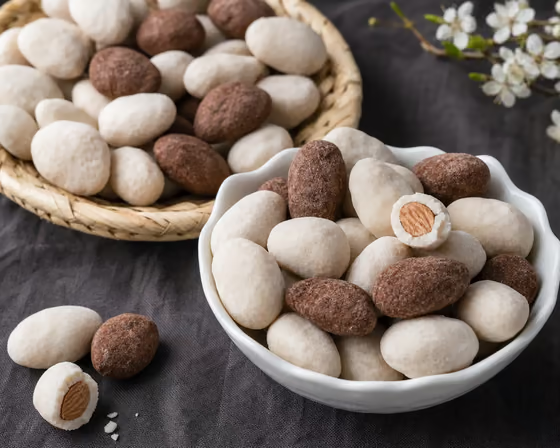 Catalogue image
 Portalegre Sugar Almonds
Almonds coated by hand in sugar, made in Portalegre for Easter.
The Alentejo